

Looking for a brain-teasing adventure that combines logic puzzle game mechanics with engaging platform puzzle challenges? Big Tall Small Math Playground is the perfect educational logic game that will test your problem-solving game for kids skills while providing hours of entertainment.
This comprehensive guide covers everything you need to know about this innovative three character puzzle experience.
Table of Contents
About Big Tall Small Puzzle Game
Big Tall Small is an innovative puzzle platformer game created by indie developer Rob1221 (Robert Alvarez) that was originally released on November 1, 2020. This character switching game has become one of the most popular titles on Math Playground and other educational gaming platforms, captivating players with its unique size-based puzzle mechanics and cooperative puzzle solving gameplay.
The game revolves around three characters with different sizes and unique abilities who must work together to navigate through increasingly complex levels. Each character possesses distinct physical traits that are essential for overcoming obstacles, activating switches, and ultimately helping all three characters reach the exit successfully.
What makes Big Tall Small game stand out is its clever integration of multiple character puzzle elements that require players to engage in strategic planning and think several moves ahead. Unlike traditional platformers where one character dominates the gameplay, this teamwork puzzle game demands that you switch between characters constantly to leverage their individual strengths.
The game has gained widespread recognition as an excellent educational logic game because it naturally develops critical thinking skills without feeling like traditional educational content. Available free to play on platforms like Math Playground, Coolmath Games, and various other browser-based game sites, Big Tall Small has become a classroom favorite for teachers seeking engaging problem-solving games for kids.
The visual design features charming, minimalist graphics with three distinct color-coded characters: Big (red), Tall (blue), and Small (yellow). Each character’s appearance immediately communicates their role and abilities, making the game accessible even for younger players while maintaining enough complexity to challenge adults.
The HTML5 port ensures that you can play Big Tall Small online free without any downloads or installations. This browser-based accessibility has contributed significantly to the game’s popularity, especially in educational settings where installation restrictions often limit gaming options. The game runs smoothly on modern browsers including Chrome, Firefox, Safari, and Edge, making it universally accessible across different devices and platforms.
How to Play Big Tall Small
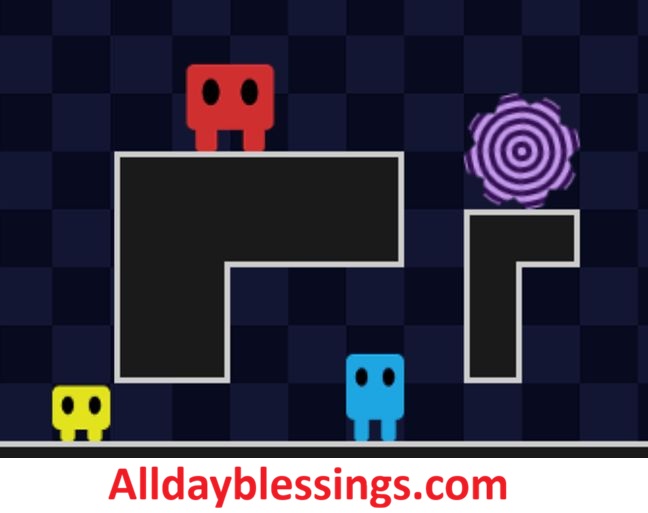
Mastering the fundamentals of Big Tall Small puzzle gameplay is essential for progressing through all 24 increasingly challenging puzzles. The core mechanic revolves around character switching game dynamics that require careful coordination and timing.
Controls & Mechanics
The control scheme for Big Tall Small Math Playground is intentionally simple, allowing players to focus on the puzzle-solving aspects rather than struggling with complicated inputs:
Keyboard Controls:
- Arrow Keys or WASD: Move the currently selected character left and right
- Up Arrow or W Key: Jump with the active character
- Down Arrow, S Key, Spacebar, or Enter: Switch between characters in sequence (Small → Tall → Big → Small)
- R Key: Restart the current level if you get stuck
Mobile/Tablet Controls:
- On-screen directional buttons: Navigate left and right
- Jump button: Make the active character leap
- Character switch button: Cycle through your three characters
The game does not allow simultaneous control of multiple characters, which is a deliberate design choice that emphasizes strategic planning. You must think ahead about which character needs to be positioned where, and in what sequence you should move them to solve challenging puzzles.
Movement mechanics vary by character size:
- Small moves quickly and has the longest jump distance relative to size
- Tall moves at medium speed with exceptional vertical jump height
- Big moves slowly but steadily, focusing on strength rather than agility
Understanding these movement differences is crucial for Big Tall Small level walkthrough success. Each level’s puzzle design requires you to recognize which character’s mobility suits specific challenges.
Environmental interactions form the backbone of puzzle mechanics:
- Switches and buttons: Can be activated by any character, but some require weight (Big)
- Doors: Open when corresponding switches are activated
- Size-specific doors: Only allow characters matching the door’s symbol to pass through
- Moving platforms: Require precise timing to board successfully
- Teleporters: Transport characters to corresponding warp points, some restricted by size
The game encourages experimentation. If a strategy doesn’t work, simply press R to restart and try a different approach. There’s no penalty for failure except time, so don’t hesitate to test various Big Tall Small puzzle solutions.
Character Abilities
Each of the three characters in this multiple character puzzle game brings unique abilities that are essential for progression:
Big (Red Character):
- Primary ability: Push and move heavy blocks
- Special trait: Immune to cannon bullets (introduced in Level 13)
- Weight advantage: Can trigger weight-sensitive pressure plates
- Movement: Slowest of the three but most powerful
- Strategic use: Block hazards like lasers, create pathways by repositioning crates, act as a shield for other characters
Big is your problem-solver for obstacles that require brute force. When you see a heavy crate blocking a path or a weight-activated switch, Big is your character of choice. The immunity to bullets becomes crucial in later levels where cannons pose significant threats to the other characters.
Tall (Blue Character):
- Primary ability: Jump to exceptional heights
- Vertical reach: Can access high platforms unreachable by others
- Movement: Medium speed with standard horizontal jump
- Strategic use: Reach elevated switches, scout upper areas, bridge gaps between different platform levels
Tall excels at vertical navigation. Whenever you encounter switches or platforms positioned high above ground level, Tall is essential. The character’s jumping prowess allows for creative pathing solutions that wouldn’t be possible with the other characters.
Small (Yellow Character):
- Primary ability: Fit through narrow gaps and small passages
- Agility: Fastest movement speed and longest horizontal jump
- Size advantage: Access restricted areas impossible for larger characters
- Strategic use: Navigate tight spaces, quickly traverse long distances, reach isolated areas
Small is your scout and infiltrator. The character’s diminutive size allows passage through gaps that would block Big and Tall, while superior agility makes Small ideal for time-sensitive maneuvers. Many levels feature sections specifically designed to require Small’s unique dimensions.
Synergy between characters: The true genius of Big Tall Small lies in how character abilities puzzle elements force cooperation. Classic combinations include:
- Big pushes a block, Tall jumps on top, Small uses both as a staircase
- Small activates a distant switch, opening a path for Big to push blocks
- Tall reaches a high switch that drops a platform for Big
- Big blocks a laser, allowing Small to safely navigate underneath
Understanding these synergies is key to how to beat Big Tall Small efficiently. The game rarely has only one solution, encouraging players to discover creative cooperative puzzle solving approaches.
Game Features & Levels
Big Tall Small Math Playground levels offer a carefully crafted progression system that introduces new mechanics gradually while maintaining engagement through increasing difficulty.
Puzzle Elements
The game incorporates diverse puzzle elements that create varied and engaging challenges:
Level 1-4: Foundation Building
- Basic movement and character switching game mechanics
- Simple switch-and-door combinations
- Introduction to platform navigation
- Learning to reach the exit with all characters
These early levels serve as the tutorial, teaching players fundamental concepts without overwhelming them. Each character’s basic abilities are showcased individually before requiring complex coordination.
Level 5: Danger Introduction
- Spikes: First deadly hazard introduced; instant death on contact
- Teaches consequence of careless movement
- Requires precision timing and careful character positioning
Level 6-10: Complexity Increase
- Multiple switches: Some doors require sequential activation
- Longer paths: Levels expand in size and required backtracking
- Timing challenges: Moving platforms require coordination
- Block manipulation: Heavy crates must be positioned strategically
This section represents the game’s transition from tutorial to genuine puzzle-solving. Players must begin thinking several moves ahead.
Level 11: Door Mechanics Evolution
- Character-specific doors: Marked with symbols showing which character can pass
- Misdirection: Upper areas may contain key items, testing observation
- Forces strategic planning about character order
Level 13: Combat Elements
- Cannons: Automated turrets that shoot bullets
- Big’s bullet immunity becomes crucial
- Requires using Big as a shield for other characters
- Starting position adjustments (patched for balance)
Level 17: Dynamic Obstacles
- Bouncing blocks: Platforms that launch characters upward when stepped on
- New vertical navigation options
- Combines with previous mechanics for complex solutions
Level 21-24: Master Puzzles
- Warps/Teleporters: Portals that transport characters
- Size-restricted warps: Only specific characters can use certain teleporters
- Multi-step solutions: Require planning the entire level sequence
- Maximum complexity: All previous elements combined
The level progression demonstrates excellent game design principles. Each new mechanic is introduced individually, practiced in isolation, then combined with previous elements to create increasingly sophisticated challenging puzzles.
Environmental hazards include:
- Spikes (Level 5+): Instant death on contact
- Lasers (Level 7+): Deadly beams that can be deactivated by switches
- Cannons (Level 13+): Automated turrets shooting bullets
- Moving platforms: Require timing and coordination
- Falling platforms: Collapse when stepped on, adding time pressure
Level Progression
The Big Tall Small Math Playground levels follow a masterful difficulty curve that keeps players engaged without causing excessive frustration:
- Early Game Philosophy (Levels 1-7): The opening levels prioritize teaching over challenge. Players learn basic mechanics through guided experiences where solutions are relatively apparent. This foundation-building phase ensures that players understand the core puzzle platformer game mechanics before complexity increases.
- Mid-Game Development (Levels 8-16): Often cited by players as where the game “really begins,” Level 8 represents a significant difficulty spike. The puzzles require genuine problem-solving rather than simple execution. Players must begin using strategic planning and consider multiple steps ahead. This section separates casual players from those seeking genuine challenging puzzles.
- Late Game Mastery (Levels 17-24): The final third introduces the most complex mechanics and requires mastery of all previous concepts. Solutions often involve intricate sequences where one misstep requires complete level restart. These Big Tall Small puzzle solutions demand patience, observation, and creative thinking.
Challenge Mode and Replayability: While the game features 24 core levels, the true depth comes from optimization. Players can replay levels seeking:
- Faster completion times: Speedrunning optimal paths
- Minimal moves: Solving puzzles with fewest actions
- Alternative solutions: Discovering different approach methods
- Perfect runs: Completing without any restarts
This replayability transforms Big Tall Small game from a short experience into an enduring challenge for completionists.
Difficulty Balancing: The game strikes an excellent balance between accessibility and challenge. Younger players can progress through early levels while developing skills, while experienced puzzle game veterans find genuine difficulty in later stages. The restart function (R key) removes frustration by allowing instant level reset, encouraging experimentation rather than punishing failure.
Educational Benefits
Big Tall Small Math Playground exemplifies how games can serve as powerful educational logic game experiences that develop crucial cognitive skills development naturally through play.
Skills Development
The character switching game mechanics inherently develop multiple cognitive abilities simultaneously:
Critical Thinking and Problem-Solving: Every level presents a unique problem requiring analysis, planning, and execution. Players must:
- Identify the objective (get all characters to exit)
- Assess available resources (character abilities, environmental elements)
- Formulate strategies (order of operations, character sequencing)
- Execute plans (precise movement and timing)
- Evaluate results (learn from failures, optimize solutions)
This problem-solving framework mirrors scientific methodology and systematic thinking approaches used across academic disciplines. Unlike direct instruction, players develop these skills experientially through trial and error.
Spatial Reasoning and Visual-Perceptual Skills: The size-based puzzle mechanics require players to mentally model three-dimensional space:
- Understanding character dimensions relative to environmental obstacles
- Visualizing which paths are accessible to specific characters
- Predicting how objects will interact when moved
- Planning trajectories for jumps and movements
Research shows that spatial reasoning correlates strongly with mathematical ability and scientific thinking. Games like Big Tall Small provide engaging spatial reasoning practice that translates to improved performance in STEM subjects.
Sequential Thinking and Planning: The inability to control multiple characters simultaneously forces sequential planning:
- Breaking complex goals into smaller sub-tasks
- Determining optimal action order
- Understanding cause-and-effect relationships
- Anticipating consequences of current actions on future options
This sequential thinking develops executive function skills crucial for academic success and real-world problem-solving.
Memory and Attention: Longer levels require players to:
- Remember switch locations and their effects
- Track which characters have completed which objectives
- Maintain focus despite increasing complexity
- Develop mental maps of level layouts
Working memory and sustained attention are foundational cognitive skills that benefit all academic areas.
Pattern Recognition: As players progress, they begin recognizing puzzle patterns:
- Common switch-and-door configurations
- Standard solutions for specific obstacle types
- Character ability applications across different contexts
- Efficient movement sequences
This pattern recognition represents a higher-order cognitive skill that accelerates learning and problem-solving across domains.
Resilience and Growth Mindset: The game’s challenge-restart-retry loop naturally develops:
- Perseverance: Continuing despite repeated failures
- Grit: Maintaining effort toward long-term goals
- Growth mindset: Viewing failures as learning opportunities
- Emotional regulation: Managing frustration constructively
These psychological traits strongly predict academic achievement and life success, arguably more important than domain-specific knowledge.
Fine Motor Skills and Hand-Eye Coordination: The precise jumping and timing requirements develop:
- Manual dexterity: Accurate button presses and timing
- Hand-eye coordination: Synchronizing visual input with motor output
- Reaction time: Responding quickly to environmental changes
While less emphasized than cognitive benefits, these physical skills support many academic and recreational activities.
Classroom Applications

Educators have embraced Big Tall Small Math Playground as an effective classroom applications tool across multiple educational contexts:
Mathematics Integration: While not explicitly mathematical, the game reinforces mathematical thinking:
- Geometry: Understanding shapes, sizes, and spatial relationships
- Measurement: Comparing character dimensions and obstacle sizes
- Problem-solving strategies: Systematic approach to challenges
- Logical reasoning: If-then conditional thinking
Teachers can use the game as a warm-up activity before mathematics lessons, priming students’ problem-solving mindset.
Computer Science Concepts: The game introduces fundamental programming concepts:
- Algorithms: Step-by-step procedures to achieve goals
- Debugging: Identifying and fixing strategy errors
- Optimization: Finding most efficient solutions
- Conditional logic: Character-specific door mechanics mirror if-statements
Coding educators use the game to introduce algorithmic thinking before transitioning to text-based programming.
STEM Challenge Activities: Math Playground specifically suggests:
- Level design challenges: Students create their own puzzle level concepts based on character traits
- Reflection discussions: Students articulate strategies they used to succeed
- Collaborative problem-solving: Pairs work together to complete difficult levels
- Strategy documentation: Students write guides explaining Big Tall Small puzzle solutions
These activities transform passive gameplay into active learning experiences that develop communication and metacognitive skills.
Special Education Applications: The game’s accessibility features support diverse learners:
- Visual learning: Heavy reliance on visual information
- Self-paced progression: No time limits or external pressure
- Immediate feedback: Clear success/failure indicators
- Incremental difficulty: Gradual skill building
Special education teachers report success using the game for students with attention difficulties, as the engaging nature maintains focus better than traditional exercises.
Social-Emotional Learning: Classroom gameplay sessions develop:
- Collaboration: Partners strategize together
- Communication: Articulating problem-solving approaches
- Empathy: Understanding others’ thought processes
- Patience: Accepting that solutions require time
Group gameplay transforms Big Tall Small into a social learning experience beyond individual cognitive development.
Assessment Tool: Educators can observe student gameplay to assess:
- Problem-solving approaches: Systematic vs. trial-and-error
- Persistence levels: How students handle challenge
- Transfer learning: Applying solutions from one level to similar challenges
- Metacognition: Awareness of own thinking processes
This authentic assessment provides insights difficult to obtain through traditional testing.
Cross-Curricular Connections: Teachers integrate the game across subjects:
- Language Arts: Writing level walkthroughs develops technical writing
- Art: Drawing character designs explores visual communication
- Physical Education: Discussing teamwork parallels in sports
- Social Studies: Comparing cooperative problem-solving across cultures
The game’s versatility makes it a valuable educational resource beyond specific subject boundaries.
Tips & Strategies
Mastering Big Tall Small Math Playground requires understanding advanced tips & strategies that go beyond basic mechanics. These techniques will help you conquer even the most challenging puzzles.
Character Prioritization Strategy:
Always plan your character order before executing moves. Consider:
- Which character needs to reach the exit first? (Usually doesn’t matter, but positioning does)
- Which character opens paths for others?
- Which character faces the most danger?
Standard approach: Small explores → Tall reaches high switches → Big manipulates heavy objects → All converge at exit. However, many levels require reversing or modifying this sequence.
Block Positioning Mastery:
When Big pushes blocks, consider multiple uses:
- Staircase creation: Stack blocks for height
- Bridge building: Position blocks across gaps
- Switch activation: Place on pressure plates
- Hazard blocking: Shield other characters from lasers or projectiles
- Platform extension: Create landing zones for jumps
Before pushing any block, visualize its final position and ensure you’re not blocking your own progress. Blocks cannot be pulled, only pushed, making some positions irreversible.
Switch Timing Optimization:
Many levels feature multiple switches affecting the same door:
- Permanent switches: Stay activated
- Temporary switches: Require constant pressure
- Sequence switches: Must be activated in specific order
Identify switch types early. Temporary switches often require positioning one character to hold it while others proceed.
Teleporter Navigation:
When warps appear (Level 21+), systematic exploration is crucial:
- Test each teleporter with different characters
- Map connections mentally or on paper
- Note size restrictions immediately
- Plan round trips: Ensure characters can return if needed
Some teleporter puzzles require sending characters through specific sequences, potentially separating them significantly before reunion.
Hazard Management Techniques:
For Spikes:
- Use Small’s agility for tight timing
- Position characters precisely at spike edges
- Remember that touching any part means death
For Lasers:
- Identify the controlling switch first
- Use Big as a shield when switches are inaccessible
- Time movements between laser patterns if they toggle
For Cannons:
- Always send Big first to clear the path
- Position Big to block bullets for other characters
- Remember cannons fire at regular intervals
For Moving Platforms:
- Observe full movement patterns before committing
- Jump slightly before platform’s direction change
- Use Small for quick boarding due to superior agility
Advanced Movement Techniques:
- Edge Jumping: Characters can jump from the very edge of platforms, maximizing distance. Practice pixel-perfect positioning to extend Small and Tall’s jump reach.
- Jump Buffering: Press jump just before landing from a previous jump to immediately execute the next one, maintaining momentum for Small’s speed runs.
- Precision Landing: For narrow platforms, approach at controlled speed rather than running jumps. Tall’s height makes landing particularly precise due to the larger hitbox.
Common Pitfall Avoidance:
- Mistake 1: Forgetting Character Order Players often forget which character is active, leading to wrong movements. Solution: Always glance at the current character before pressing movement keys.
- Mistake 2: Irreversible Block Positioning Pushing blocks into corners or against walls can make levels unsolvable. Solution: Plan the entire block path before pushing.
- Mistake 3: Leaving Characters Behind Focusing on one character and forgetting others’ positions leads to inefficient backtracking. Solution: Mentally track all three locations constantly.
- Mistake 4: Rushing Timing Sections Moving platforms and toggling hazards require patience. Solution: Observe full cycles before attempting passage.
Level-Specific Walkthroughs:
For Big Tall Small level walkthrough assistance on particularly challenging stages:
- Level 8 Strategy: This level introduces significant complexity. Focus on using Tall to access upper areas first, creating pathways for Big to push blocks into strategic positions that Small can then utilize.
- Level 11 Strategy: The character-specific doors require careful planning. The upper key mentioned in wikis tricks players—it’s accessible but requires specific character sequencing to retrieve.
- Level 13 Strategy: Cannon introduction level. Always move Big first to draw fire and clear paths. Use Big to shield other characters during their navigation.
- Level 17 Strategy: Bouncing blocks add vertical mobility. Combine bounce mechanics with Tall’s jumping for maximum height access.
- Level 21+ Strategy: Teleporter levels require systematic exploration. Test every warp combination, noting size restrictions carefully before committing to complex sequences.
Optimization for Speedrunning:
For players seeking how to beat Big Tall Small with minimal time:
- Minimize backtracking: Plan efficient paths
- Use Small’s speed: Leverage fast movement whenever possible
- Perfect timing sections: No hesitation on moving platforms
- Know switch locations: Memorize optimal routes
- Reduce switches: Some switches might be unnecessary for alternative solutions
Reset Strategy:
Don’t hesitate to press R and restart. Professional puzzle gamers often restart levels multiple times during planning phases. If a strategy isn’t working after 2-3 attempts, completely reconsider your approach rather than persisting with flawed logic.
Learning From Failure:
Each failed attempt provides information:
- Which paths are viable?
- Which character orders work/don’t work?
- Where are the dangerous zones?
- What alternative approaches exist?
Treat restarts as data collection rather than failure. The best Big Tall Small puzzle solutions often emerge after multiple failed attempts reveal hidden patterns.
Frequently Asked Questions
Q: Can I play Big Tall Small on mobile devices?
Yes, the HTML5 version works on mobile browsers with touch controls adapted for on-screen buttons.
Q: How many levels does Big Tall Small have?
The game features 24 progressively challenging levels that introduce new mechanics throughout.
Q: Is Big Tall Small free to play?
Absolutely! You can play Big Tall Small online free on Math Playground and several other browser gaming platforms.
Q: What age group is Big Tall Small suitable for?
While designed for kids 6+, the later levels challenge players of all ages with complex puzzle-solving requirements.
Q: Do I need to download anything to play?
No downloads required! The HTML5 version runs directly in modern web browsers without plugins or installations.
Q: Can multiple players play Big Tall Small together?
It’s single-player, but many players enjoy collaborative problem-solving where one person controls while others suggest strategies.
Q: Are there similar games to Big Tall Small?
Yes! Games like The Lost Vikings, Trine, and other character-switching puzzle platformers share similar mechanics.
Q: What skills does Big Tall Small help develop?
The game develops critical thinking, spatial reasoning, sequential planning, problem-solving, and perseverance in both children and adults.
Q: How long does it take to complete Big Tall Small?
First-time completion typically takes 2–4 hours depending on puzzle-solving experience and age. Speedrunners finish much faster.
Q: Is there a save system in Big Tall Small?
The game autosaves progress automatically, allowing you to return to your current level later.
Q: What’s the hardest level in Big Tall Small?
Players commonly cite Levels 8, 13, 17, and the final 21–24 sequence as particularly challenging.
Q: Can I play Big Tall Small at school?
Yes! It’s available on Math Playground specifically for educational use and works on most school networks.
Similar Games You’ll Love
If you enjoyed Big Tall Small Math Playground, these character switching game and puzzle platformer game titles offer similar cooperative puzzle solving experiences:
| Game Title | Key Features | Platform |
| The Lost Vikings | Classic 3-character puzzle platformer that inspired Big Tall Small | PC, Console, Modern Ports |
| Trine Series | Three heroes with unique abilities solving physics-based puzzles | PC, Console |
| Brothers: A Tale of Two Sons | Control two characters simultaneously using dual analog sticks | PC, Console, Mobile |
| Fireboy and Watergirl | Cooperative puzzle series requiring elemental character coordination | Browser, Mobile |
| Limbo | Dark atmospheric puzzle platformer with physics-based challenges | PC, Console, Mobile |
| Inside | Spiritual successor to Limbo with mind-bending puzzle mechanics | PC, Console, Mobile |
| Oddmar | Viking-themed platformer with puzzle elements and beautiful art | Mobile, PC |
| Unravel Two | Cooperative puzzle platformer controlling two yarn characters | PC, Console |
| Little Nightmares | Atmospheric puzzle platformer requiring timing and observation | PC, Console |
| BADLAND | Physics-based side-scrolling puzzle game with atmospheric design | Mobile, PC, Console |
Character-Switching Focused Games:
- The Lost Vikings 2: Direct sequel expanding original mechanics
- Animaniacs (Mega Drive/Genesis): Cartoon-based multi-character platforming
- Bugs Bunny & Taz: Time Busters: Character-swap combat and puzzle solving
- Ed, Edd n Eddy: Jawbreakers: GBA title with character-specific abilities
- Teen Titans (GBA): Character switching with unique superhero powers
Educational Puzzle Games:
- Bloxorz: Block rotation puzzle challenging spatial reasoning
- Factory Balls: Logic puzzle requiring step-by-step planning
- Sugar, Sugar: Physics-based puzzle about directing substances
- Civiballs: Cut-the-rope style physics puzzle with historical themes
- Cut the Rope: Physics puzzle requiring timing and precision
Team-Based Puzzle Platformers:
- ibb and obb: Gravity-manipulating cooperative puzzle platformer
- Snipperclips: Creative cutting puzzle solving in pairs
- Overcooked Series: Cooperative cooking requiring teamwork and coordination
- Lovers in a Dangerous Spacetime: Cooperative spaceship management and navigation
- Keep Talking and Nobody Explodes: Cooperative bomb defusal puzzle game
Browser-Based Logic Games:
- World’s Hardest Game: Precision timing and pattern recognition
- A Small Car: Physics-based vehicle navigation puzzles
- Red Ball 4: Rolling physics platformer with puzzle elements
- Snail Bob Series: Path-creation puzzle platformer
- Money Movers: Prison escape game with two-character cooperation
These games share core elements with Big Tall Small puzzle mechanics, whether through multiple character puzzle dynamics, cooperative puzzle solving requirements, or character abilities puzzle challenges that require strategic planning and creative thinking.
Conclusion
Big Tall Small Math Playground stands as an exceptional example of how puzzle platformer games can simultaneously entertain and educate. Through its clever character switching game mechanics, size-based puzzle mechanics, and teamwork puzzle game design, it creates an experience where three characters with different sizes and unique abilities must work together and solve challenging puzzles to reach the exit.
The game’s strength lies in its accessibility combined with depth. Beginners can enjoy early levels while learning fundamental problem-solving game for kids concepts, while experienced players find genuine challenge in later Big Tall Small Math Playground levels that demand mastery of all mechanics. The strategic planning required to guide all characters successfully creates a satisfying cognitive workout that develops crucial skills transferable to academic and real-world situations.
For educators, Big Tall Small offers a classroom-ready educational logic game that engages students while developing critical thinking, spatial reasoning, and problem-solving abilities. The platform puzzle challenges naturally promote discussion, collaboration, and metacognitive reflection—all valuable educational outcomes beyond mere entertainment.
Whether you’re seeking Big Tall Small level walkthrough guidance, Big Tall Small puzzle solutions for challenging stages, or simply want to play Big Tall Small online free for engaging entertainment, this game delivers a polished experience that respects players’ intelligence while providing appropriate support through its gradual difficulty progression.
The game’s HTML5 accessibility means you can start playing immediately in any modern browser without downloads or installations. As a logic puzzle game that combines multiple character puzzle dynamics with cooperative puzzle solving requirements, Big Tall Small continues to captivate players of all ages worldwide, proving that excellent game design transcends age barriers and creates universally enjoyable experiences.
Ready to test your puzzle-solving prowess? Visit Math Playground now and experience why Big Tall Small game has become one of the most beloved puzzle platformer game titles in educational gaming. Guide your three characters through increasingly complex platform puzzle challenges, master each character’s unique abilities, and prove you have the strategic planning skills needed to conquer all 24 levels. The journey of cooperative puzzle solving awaits!

I’m Watson, a faith-inspired writer passionate about sharing heartfelt blessings and uplifting words that bring peace, gratitude, and hope. Through my daily blessings, I aim to comfort the soul and inspire spiritual growth.